
The escalating conflict in West Asia has resulted in 19 ships carrying essential energy resources for India being stranded in the Strait of Hormuz, raising concerns about potential disruptions to the country's energy supply.

A recently finalised peace deal between the US and Iran, set to be signed on June 19, is expected to significantly benefit India's economy by boosting exports to West Asia, stabilising the rupee, and easing inflationary pressures, according to exporters and experts.

The reopening of the Strait of Hormuz, following a ceasefire agreement between the US and Iran, is expected to significantly ease India's crude oil supply risks, lower freight costs, and reduce inflationary pressures, as global oil prices have already dropped.

India significantly increased its crude oil imports from Russia and the United Arab Emirates in June, securing supplies as the Strait of Hormuz began to reopen, with Russian barrels remaining attractive due to discounts and UAE supplies offsetting earlier uncertainties.

The government has introduced a mandatory 25-day gap between LPG cylinder bookings due to supply concerns arising from global disruptions and tensions in the Strait of Hormuz. This measure aims to prevent hoarding and prioritise essential non-domestic sectors, while domestic LPG production is being increased to mitigate shortages.

Indian benchmark equity indices, Sensex and Nifty, closed lower due to investor caution over rising bond yields, a weaker rupee, and fresh fuel price hikes, which have revived inflation concerns.

Major paint companies in India, including Asian Paints, Berger Paints, Akzo Paints, and Kansai Nerolac, have announced price hikes ranging from 1% to 8% across various product lines, effective from mid-March to late April, in response to persistently high crude oil and gas prices.

Beijing clearly intends to extend the China-Myanmar Economic Corridor to Bangladesh as part of its larger Maritime Belt and Road Initiative to boost its Indian Ocean presence.

India possesses two months of fuel stockpiles and faces no supply concerns despite global energy disruptions, according to Oil Minister Hardeep Singh Puri. However, state-run fuel retailers are incurring losses of up to Rs 1 lakh crore in a single quarter due to elevated crude prices and unchanged retail fuel prices, raising questions about the sustainability of these losses.

Two more Indian-flagged LPG tankers have safely navigated the Strait of Hormuz, ensuring continued cooking gas supply to India amidst regional conflict. These tankers are expected to reach Indian shores soon, following the successful transit of previous vessels.

Global oil prices fell on Thursday to their lowest levels since before the outbreak of the Iran conflict, offering a significant economic tailwind for India, the world's third-largest crude importer, by easing inflation risks, reducing the import bill and improving the government's fiscal position.

India's exports experienced their steepest fall in five months, declining by 7.44 per cent in March to $38.92 billion, primarily due to trade uncertainty and geopolitical tensions, with shipments to West Asia contracting by over 50 per cent.

Hours after warning that the United States could strike Iran "very hard tonight", President Donald Trump announced to halt planned military action, despite earlier threats to target Kharg Island and other key Iranian oil facilities.

From the 30 Sensex firms, IndusInd Bank, Asian Paints, Hindustan Unilever, Tata Motors, Tata Steel, Titan, Reliance Industries and NTPC were among the major laggards. Tech Mahindra, Mahindra & Mahindra, Kotak Mahindra Bank, Infosys, HCL Technologies and State Bank of India were among the major gainers.

Insights from behavioural economics suggest that an ambitious nudge can be effective if three conditions are met, points out Ram Singh Insights from behavioural economics suggest that an ambitious nudge can be effective if three conditions are met, points out Ram Singh, director, Delhi School of Economics.
Live updates on the US-Israel-Iran war: Trump escalates threats, Iran retaliates, and oil prices surge as the Strait of Hormuz crisis disrupts global markets.

The United States and India are on the verge of finalising a landmark bilateral trade deal, aiming to boost trade to USD 500 billion by 2030, according to US Deputy Assistant Secretary of State Bethany Poulos Morrison. The agreement seeks to open India's 1.4 billion-strong market to American goods on reciprocal terms, with ongoing high-level discussions to recalibrate the pact after recent changes in US tariff policy.

Reliance Industries Ltd (RIL) has expressed caution regarding 'extreme volatility' risks stemming from the West Asian conflict, which could impact global oil demand and the company's margins, while also noting that near-term retail consumption demand may remain sensitive to macro conditions. Chairman Mukesh Ambani, in the annual report, remained silent on the timeline for Jio Platforms' anticipated public listing, stating the group will 'continue to evaluate strategic pathways'.

India emerged reasonably well from 2025. But now, the oil shock and war-related supply disruptions have again driven funds out of India and significantly weakened the rupee, points out Ajay Chhibber.

India's plans to ration the consumption of liquefied natural gas (LNG) and liquefied petroleum gas (LPG) - in response to reduction in their import owing to war in West Asia - may fall short of what is needed to meet domestic needs.
India possesses approximately 100 million barrels of commercial crude oil stocks, capable of covering 40-45 days of its requirements if flows through the Strait of Hormuz are disrupted, according to Kpler.

Bharat Forge reported modest Q4FY26 results but provided strong guidance, anticipating significant growth from its defence, aerospace, and data centre segments, with a projected 25 per cent revenue growth in Indian manufacturing for FY27, despite current high valuations.

'Actual implementation of the 14-point agreement is proving hard to achieve let alone striking and sustaining a long-term treaty or deal.'

Nomura has increased its March 2027 target for the Nifty 50 to 25,900, driven by strong corporate earnings and attractive market valuations, even as risks from the West Asia conflict and high oil prices persist.

Will rising tensions between US-Israel and Iran threaten crude oil supply through the Strait of Hormuz, putting India's fuel prices, imports, and economic stability at risk?
India has gained the least since Russia invaded Ukraine in February 2022 and was penalised the most, while the US, China and the European Union emerged as the biggest beneficiaries from the war.

India's trade with West Asia saw a significant decline of over 28% in April, marking the second consecutive month of contraction. This downturn is attributed to severe shipping disruptions stemming from the ongoing conflict involving the US, Israel, and Iran, particularly impacting the crucial Strait of Hormuz waterway.

India is well-stocked with inventories of crude oil and key petroleum products, including petrol, diesel, and aviation turbine fuel (ATF), to deal with short-term disruptions as the war intensifies in West Asia, Union Minister of Petroleum and Natural Gas Hardeep Singh Puri said on Tuesday.
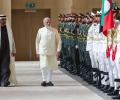
Prime Minister Narendra Modi has offered India's support to bring peace to West Asia during talks with UAE President Sheikh Mohamed bin Zayed Al Nahyan. Both countries signed agreements to strengthen strategic collaborations in energy and defence.

'OMCs are incurring losses of Rs 1,000 crore per day due to the West Asia crisis.'

An Indian-flagged LPG vessel successfully transited the Strait of Hormuz, reducing the number of Indian ships stranded in the Persian Gulf. India is in talks with Iran to ensure safe passage for its tankers, and Indian refiners continue to purchase crude oil and LPG from Iran despite regional tensions.

Indian private sector and State-run refiners continued to receive crude oil from Russian suppliers even after November 21 -- the winding-down date for US sanctions on supplies from leading Russian oil producers imposed in October -- as new intermediaries sprung up in West Asia to sell the oil, according to senior refining sources and ship tracking data.
The United Arab Emirates has announced its decision to withdraw from OPEC and the wider OPEC+ alliance, effective May 1, 2026, signalling a significant policy-driven evolution in its long-term energy strategy aimed at aligning with domestic economic goals and increased production investment.

'The West Asia or the Gulf crisis has shown that what we develop as national infrastructure when things are not as bad as they could be, we forget to plan for adversities.'
The United Arab Emirates has announced its decision to withdraw from OPEC and the wider OPEC+ alliance, effective May 1, 2026, signalling a significant policy-driven evolution in its long-term energy strategy aimed at aligning with domestic economic goals and increased production investment.
Bank of Baroda economists project India's GDP to grow 6.5-6.8 per cent in FY27 but warn that the fiscal deficit could overshoot the budgeted 4.3 per cent target, potentially reaching 4.7-4.8 per cent of GDP due to subsidy overruns, excise duty cuts, and oil marketing company losses.

Analysts predict India will face oil price volatility and macroeconomic effects due to the escalating Iran crisis, though the country's oil supply chain is not yet structurally insecure.

West Asia conflict triggers sharp sell-off in Indian markets, with realty, banking and auto stocks leading losses amid energy shock fears.

India's sugar consumption is projected to fall by nearly 400,000 tonnes in the 2025-26 season, primarily due to the ongoing liquefied petroleum gas (LPG) shortage exacerbated by the West Asia conflict and unseasonably cool weather.

'In all these years of rupee depreciation, of rising oil prices, of inflation caused by import dependence, not one leader had the courage to look the people in the eye and say: Please do this for your country.'
